Usługi profesjonalne · Ubezpieczenia
Aplikacje AI dla ubezpieczycieli i brokerów
Kieruj pierwsze zgłoszenia szkód, streszczaj akta szkód, wyjaśniaj polisy prostymi słowami i przygotowuj odnowienia.
Co przejmują te aplikacje
- Szkody skierowane
Sklasyfikuj pierwsze zgłoszenie szkody, oceń jej wagę i streść akta szkody w zestawieniu.
- Polisy wyjaśnione
Przeredaguj warunki polisy prostym językiem i sprawdź, czy ochrona nie ma luk względem potrzeb klienta.
- Odnowienia przygotowane
Wyciągnij wnioski z historii szkód i przygotuj korespondencję o odnowieniu do klienta.
Aplikacje dla tej branży
- FNOL Triage Router
Turns a first-notice-of-loss call into a routed claim ticket with line of business, peril, team and urgency.
- Claim File Digest
Condenses messy adjuster file notes into a dated event recap, a current position and the next actions.
- Plain Policy Rewrite
Rewrites a policy clause into plain language a policyholder can actually understand, keeping every condition intact.
- Loss Run Insights
Reads a pasted loss run and returns claim totals, the largest losses, the dominant cause and underwriting comments.
- Coverage Gap Scan
Compares a client's current coverages against what their business actually does and lists the likely gaps.
- Renewal Outreach Draft
Writes a short renewal email inviting the client to review the account before the expiry date.
- Claim Severity Grade
Grades an incoming claim from one to five for severity and tells the adjuster what to do first.
- Subrogation Screen
Says whether a paid claim is worth pursuing against a third party and what evidence is still missing.
- Denial Notice Draft
Drafts a respectful claim declinature letter that applies the quoted policy wording to the claim facts.
- Submission Field Capture
Pulls the structured submission fields out of a broker's new-business email so the file can be keyed in.
- Endorsement Request Parser
Reads a client's mid-term change request and outputs the endorsement fields plus what still needs confirming.
- Fraud Indicator Sweep
Flags recognised fraud indicators in a claim narrative and recommends whether to refer it to investigators.
- Injury Report Simplifier
Turns a clinical injury narrative into a plain-language brief a non-medical bodily injury adjuster can act on.
- Quote Comparison Brief
Compares competing insurer quotes on premium, limits, deductibles and exclusions and explains the trade-off.
- Complaint Response Draft
Drafts a point-by-point complaint reply stating whether each grievance is upheld and what happens next.
- Certificate Wording Check
Says whether a requested certificate of insurance wording can be issued against the coverages actually held.
- Policy Notice Translator
Translates a policyholder notice into another language while preserving every deadline, limit and legal term.
- Objection Practice Partner
Role-plays a prospect raising a chosen objection, then coaches the agent through three ways to answer it.
- Underwriting Risk Grade
Grades a submitted risk from one to five and names the information needed before a quote can be released.
- Claims Call Opener
Gives the claims handler a ready call opening, an empathy line and the first three questions to ask.
- Repair Estimate Review
Reviews a contractor's repair estimate line by line against the damage described and flags the questionable items.
- Total Loss Decision
Says whether a damaged vehicle or property should be repaired or written off, and what still needs checking.
- Recorded Statement Script
Builds an ordered question script for taking a recorded statement about a specific loss.
- Settlement Breakdown Note
Writes a customer-facing note explaining exactly how a claim payment figure was reached.
- Demand Letter Digest
Condenses a claimant lawyer's demand package into the allegations, the amounts claimed and the deadline given.
- Claim Evidence Checklist
Lists the documents and proofs still needed to progress a claim, and who has to supply each one.
- File Quality Audit
Scores a closed claim file against handling standards and names what the handler should have done differently.
- Adjuster Instruction Brief
Drafts the letter appointing a loss adjuster or expert, with the scope and the questions their report must answer.
- COPE Property Profile
Extracts construction, occupancy, protection and exposure facts from a property description into a structured profile.
- Appetite Match Check
Says whether a submitted risk fits the underwriting appetite you paste in, and exactly where it falls outside.
- Submission Decline Note
Writes a courteous note declining a broker's submission and saying what would make it acceptable.
- Referral Authority Memo
Turns a risk that exceeds your authority into a referral memo asking a senior underwriter for a decision.
- Survey Recommendation List
Turns risk survey findings into prioritised recommendations with an owner and a suggested condition of cover.
- Location Schedule Parser
Turns a messy pasted schedule of values into clean per-location rows plus the totals those rows contain.
- Treaty Slip Summary
Summarises a reinsurance slip or treaty extract into the terms a cedant needs at a glance.
- Life Disclosure Review
Reads an applicant's health and lifestyle disclosures and lists the follow-up questions and evidence to request.
- Benefits Plan Explainer
Explains an employee benefits option in plain language so staff see what it covers and what it costs them.
- Illustration Plain Summary
Explains what a life or annuity illustration actually shows, in plain language and without any advice.
- Conduct Call Review
Scores a sales or servicing call transcript against conduct expectations and flags every line needing coaching.
- Ad Wording Compliance
Scans insurance marketing copy for unsupported promises, missing caveats and wording a regulator would challenge.
- Vulnerability Signal Check
Flags signs of customer vulnerability in a call note and says how the handler should adjust their approach.
- Policy Summary Sheet
Turns a full policy schedule into a one-page client summary of cover, limits, excesses and key conditions.
- Market Submission Letter
Writes the cover letter that presents a risk to underwriters alongside the submission pack.
- Coverage Position Note
Applies the policy wording you paste to a described incident and returns an indicative coverage position.
- Insurance Jargon Decoder
Explains every piece of insurance jargon in a pasted document in plain terms for the person reading it.
- Wording Change Compare
Compares two versions of a policy wording and lists every material difference and who it favours.
- Police Report Extract
Turns an accident or police report into a structured statement of the facts of loss for the claim file.
- Medical Bill Review
Reads an itemised medical bill from an injury claim and returns a line-by-line summary with totals, dates of service and items to query.
- Exclusion Clause Finder
Lists every exclusion, condition precedent and inner limit in a policy wording, with the clause reference for each.
- Proof Of Loss Check
Checks a submitted proof of loss for the elements it must carry and returns accept, return to insured, or query.
- Bordereau Data Check
Scores a delegated authority bordereau for data quality and lists the rows and columns that will fail the carrier's ingestion.
- Certificate Expiry Sweep
Turns a spreadsheet of contractor or tenant insurance certificates into a dated list of what has lapsed and what expires next.
- Claims Register Triage
Sorts an open claims export into a ranked worklist showing which files need attention first and why.
- Contract Insurance Requirements
Pulls the insurance obligations out of a lease or supplier contract so the broker can test the client's cover against them.
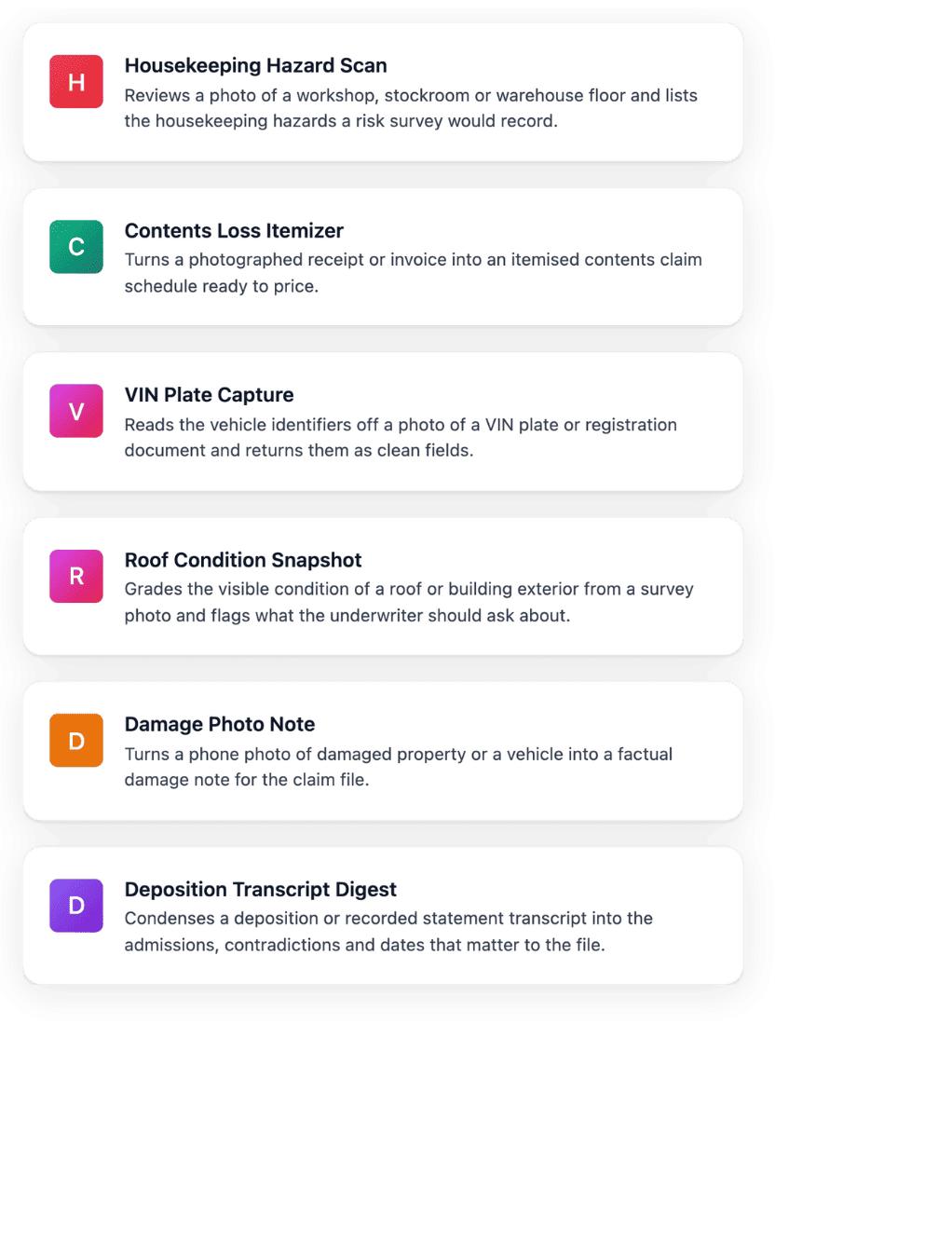
- Deposition Transcript Digest
Condenses a deposition or recorded statement transcript into the admissions, contradictions and dates that matter to the file.
- Damage Photo Note
Turns a phone photo of damaged property or a vehicle into a factual damage note for the claim file.
- Roof Condition Snapshot
Grades the visible condition of a roof or building exterior from a survey photo and flags what the underwriter should ask about.
- VIN Plate Capture
Reads the vehicle identifiers off a photo of a VIN plate or registration document and returns them as clean fields.
- Contents Loss Itemizer
Turns a photographed receipt or invoice into an itemised contents claim schedule ready to price.
- Housekeeping Hazard Scan
Reviews a photo of a workshop, stockroom or warehouse floor and lists the housekeeping hazards a risk survey would record.
Katalog, w Twojej przestrzeni roboczej
The same applications are in the catalogue of your Reasoning workspace, filtered by trade. Open one to run it on your own text, or add it as a step of a chain.
Jak działa aplikacja
- Wybierz zadanie
Każda aplikacja obejmuje jedno zadanie z branży, opisane jednym zdaniem.
- Wypełnij pola
Wklej notatki, wiadomość lub fragment dokumentu do pól, o które prosi aplikacja.
- Wykorzystaj odpowiedź
Odczytaj uporządkowany wynik, który możesz skopiować, wysłać lub zarchiwizować, albo pobierz go przez API Ultineo Reasoning.
Przekaż te zadania Ultineo Reasoning
Powiedz nam, jakich aplikacji potrzebuje Twój zespół, a otworzymy Ci dostęp.
Pytania o te aplikacje
Yes. You can customize the applications, so their fields and instructions follow your own practice.
Tylko treść, o którą proszą pola, na przykład notatki, wiadomość lub fragment dokumentu. Nie udostępniaj więcej danych osobowych, niż wymaga zadanie.
Tak. API Ultineo Reasoning uruchamia każdą aplikację, z której może korzystać Twój projekt, i zwraca jej odpowiedź po zakończeniu uruchomienia.